
Side Dishes
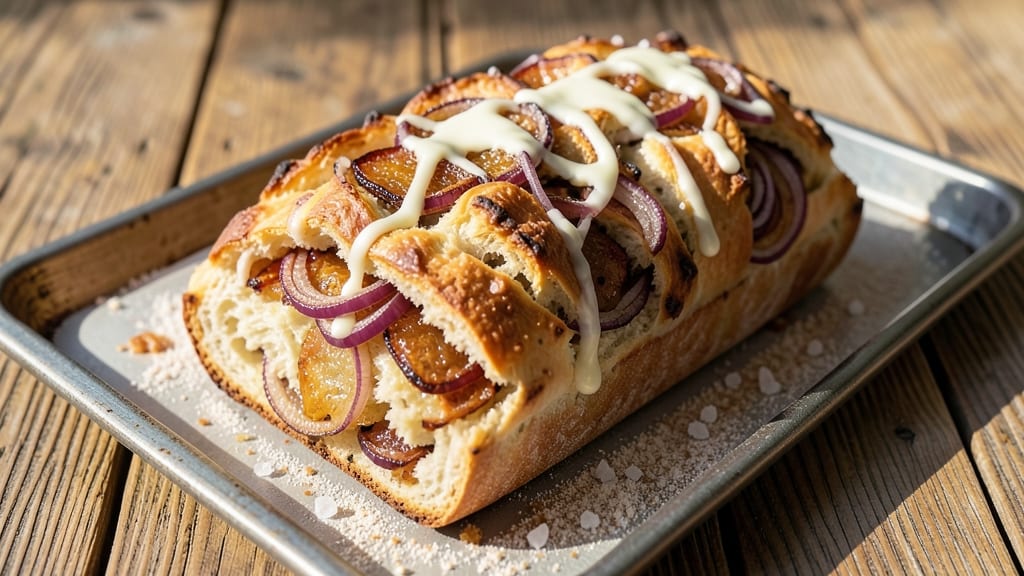
This artisan onion bread recipe delivers a crispy cornmeal crust wrapped around layers of caramelized onions and tender dough—perfect for elevating any meal. 🌟 The secret lies in slow-cooked onions that develop deep sweetness while the cornmeal crust adds a satisfying crunch that contrasts beautifully with the soft interior.
I’ve perfected this technique over years of baking, ensuring every slice delivers that perfect balance of textures and flavors.
The dough begins with a simple yeast-based mixture, but what sets this recipe apart is the lamination technique that creates airy pockets while keeping the structure intact.
Caramelizing the onions in butter and sugar until they’re deep amber and jammy takes patience, but the reward is a flavor that’s rich and complex. The cornmeal crust, toasted until golden, adds a rustic charm that makes this bread feel like a true artisan creation.
Once baked, you’ll have a loaf with a crisp exterior that shatters slightly with each bite and a soft, slightly chewy interior infused with sweet onions.
The aroma alone will have everyone gathering at the table, and the first slice reveals layers of flavor that make it worth every minute of preparation. This bread pairs beautifully with soups, stews, or even as a standalone treat with butter.
For those who love tradition, this recipe stays true to classic methods while offering a modern twist with the cornmeal crust. Whether you’re baking for a holiday feast or simply craving something special, this artisan onion bread will become a staple in your kitchen.
Let’s get started on creating something truly memorable.
Ingredients for artisan onion bread
Eight simple ingredients transform into artisan onion bread with crispy cornmeal crust and caramelized sweetness.
| Ingredient | Amount | Notes |
|---|---|---|
| Yellow Onions 🧅 | 4 large | Peeled and thinly sliced |
| Unsalted Butter 🧈 | 1 cup | Cold, cubed for caramelizing |
| Granulated Sugar 🍚 | ¼ cup | Light brown preferred |
| Active Dry Yeast 🍞 | 2 ¼ tsp | Freshly opened package |
| All-Purpose Flour 🌾 | 5 cups | Sifted for light texture |
| Cornmeal 🌽 | 1 cup | Fine grind for crust |
| Large Eggs 🥚 | 1 whole | Room temperature |
| Whole Milk 🥛 | ½ cup | Warm for yeast activation |
| Salt 🧂 | 1 ½ tsp | Kosher or sea salt |
| Garlic Cloves 🧄 | 3 cloves | Minced for dough flavor |
| Honey 🍯 | 1 tbsp | For dough enrichment |
| Corn Oil 🫒 | 2 tbsp | For dough lamination |
The yellow onions are the heart of this recipe—4 large ensures plenty of caramelized sweetness. Look for onions with dry, papery skins and firm flesh; Whole Foods or local farmers' markets often carry the freshest varieties. The unsalted butter should be high-quality like Plugrá or Land O'Lakes Organic—it's what creates that rich, golden caramelization. For the cornmeal, Bob's Red Mill fine grind is ideal, but any fine-ground cornmeal will work. The active dry yeast must be fresh; test by dissolving 1 tsp in warm water—it should foam within 5 minutes.
No light brown sugar? White sugar plus 1 tsp molasses mimics the flavor. All-purpose flour can be swapped for bread flour for a slightly chewier texture, but sift it to avoid dense bread. The corn oil is crucial for lamination—Avocado Brand is reliable, but any neutral oil works. For the garlic, fresh is best, but garlic powder at half the amount works in a pinch. Room temperature egg and warm milk are non-negotiable for proper yeast activation. If your kitchen is cold, warm the milk to 110°F and let the egg sit out for 10 minutes.
Store the caramelized onions in an airtight container in the fridge for up to 5 days, though they're best used immediately. The dough can rise overnight in the fridge for deeper flavor—just let it sit at room temperature for 30 minutes before shaping. Baked loaves keep well wrapped at room temperature for 2 days or frozen for 3 months. For extra crunch, toast slices in a 350°F oven for 5 minutes before serving.
Why You'll Love This Recipe
- Sweet Caramel Crunch: I’ll be real—caramelized onions take patience, but this recipe cuts corners just enough. You don’t need hours: a quick sauté with sugar and butter turns those onions into sticky, golden pockets of flavor that melt into the dough. That first bite? Pure satisfaction.
- Pantry Staple Magic: Between us, this uses ingredients you already own. Flour, yeast, butter—no obscure spices or specialty flours here. Honestly, the only thing you might need to buy is extra onions, but they last forever, so it’s a win. Budget-friendly doesn’t mean boring, and this bread proves it.
- Weeknight Hero: I make this when I forget to plan dinner. Toast it straight from the oven with butter and jam for breakfast, tear it into soup bowls, or serve it alongside pasta—it’s the ultimate sidekick. No fuss, no stress, just reliable deliciousness that disappears faster than you can say “second slice.”
- Leftovers That Shine: This bread stays fresh for days, and the best part? It improves with age. The crust gets crunchier, the onion flavor deepens, and you can reheat slices in the toaster or oven until they’re crisp again. (Yes, even on a Tuesday night.)
Step-by-step instructions for artisan onion bread recipe
Here's how to craft bread with a golden cornmeal crust and layers of caramelized onions.
🍳 Step 1: Caramelize the Onions
In a large skillet, melt the 1 cup unsalted butter over medium-low heat. Add the 4 large yellow onions (peeled and thinly sliced) and sprinkle with 0.25 cup granulated sugar. Stir occasionally for 30-35 minutes until the onions turn deep golden brown and sweet-smelling.
Here's the thing—patience matters. The onions should reduce to about 2 cups of jammy, concentrated flavor. If they stick, add a splash of water and scrape the bottom with a wooden spoon. Once caramelized, transfer to a bowl and let cool completely before mixing into the dough.
👨🍳 Step 2: Prepare the Dough
In a stand mixer fitted with the dough hook, combine the 5 cups all-purpose flour, 1.5 tsp salt, and 2.25 tsp active dry yeast. Mix on low speed for 30 seconds to blend. In a separate bowl, whisk together the 0.5 cup warm whole milk, 1 whole large egg, 1 tbsp honey, and 2 tbsp corn oil. Pour into the flour mixture and mix on low speed for 2 minutes until combined.
Add the cooled caramelized onions and 3 minced garlic cloves. Knead on medium speed for 5-7 minutes until the dough becomes smooth and elastic, pulling away from the bowl. If it's too sticky, add 1 tablespoon flour at a time until it reaches the right consistency.
🥘 Step 3: First Rise and Shaping
Lightly oil a large bowl, place the dough inside, and cover with a damp towel. Let it rise in a warm place for 1-1.5 hours or until doubled in size. The dough should feel springy when pressed gently with a finger—this is your signal it's ready.
Punch down the dough to release air, then divide it into 8 equal portions. Roll each portion into a 12-inch rope, then coil them into loose spirals. Arrange the spirals on a parchment-lined baking sheet, leaving 2 inches of space between each.
🔥 Step 4: Second Rise and Baking
Cover the shaped dough with a towel and let it rise for another 30-45 minutes until puffy. Preheat your oven to 375°F and sprinkle the 1 cup cornmeal evenly over the baking sheet. This creates that signature crispy crust we're after.
Bake for 25-30 minutes until the bread turns a deep golden brown and sounds hollow when tapped on the bottom. The cornmeal crust should be crackly and crispy—this is where the magic happens. If the top browns too quickly, tent loosely with foil after 20 minutes to prevent over-browning.
⏰ Step 5: Cool and Serve
Remove the bread from the oven and let it cool on the baking sheet for 10 minutes before transferring to a wire rack. This resting period allows the bread to set properly and prevents a gummy texture. Slice while still warm for the best experience—each piece should reveal layers of caramelized onions and a crispy cornmeal crust.
For extra crispiness, serve immediately with a pat of softened butter or a drizzle of honey. The contrast between the sweet caramelized onions and the savory, crispy crust makes every bite worth the effort.
Pro Tips For Making Artisan Onion Bread
- USE COLD BUTTER: Fold that unsalted butter into the dough while it’s still chilled—yes, even if the recipe says room temp. I learned this the hard way when my last batch turned out greasy and dense. Cold butter creates pockets that make the bread tender and crispy, not a sad, soggy mess.
- CARAMELIZE ONIONS LOW: Skip the high-heat rush and let those onions slow-cook for 20-25 minutes until deep amber, not just golden. I used to speed this up, but the flavor was always flat. Low heat (medium-low) builds sweetness and depth—your bread will taste like it came from a bakery, not a microwave.
- STOP KNEADING WHEN IT’S TOUGH: The dough should spring back when poked but still feel slightly sticky—not gluey, not dry. Over-kneading develops gluten like crazy, and your bread will turn out chewy instead of tender. Two minutes past that point is two minutes too long.
- PROOF IN A WARM DRAFT-FREE SPOT: Your oven’s light-on setting isn’t foolproof—use a bowl of hot water inside the turned-off oven for steady warmth. I tried the countertop method once, and the dough took forever to rise. A consistent 78°F (26°C) speeds things up without overproofing. (Pro tip: Check for readiness by pressing gently—if it springs back fast, it’s ready.)
Essential equipment for perfect results
Dough Mixer Essentials
Your stand mixer is non-negotiable for this recipe—I use a KitchenAid Artisan Series for its powerful motor and durable construction. The dough hook attachment is critical for achieving that perfect elastic texture without overworking the gluten.
If you don’t have a mixer, a wooden spoon and strong arms will work, but expect to spend 10-15 minutes kneading by hand. For budget-friendly options, the Cuisinart Smart Mixer offers similar performance at a lower price. 💪
Caramelization Tools
A 10-inch cast iron skillet is ideal for caramelizing onions due to its even heat distribution and heavy weight, which prevents burning. I prefer Lodge cast iron for its durability and natural non-stick properties after proper seasoning.
For a lighter option, a stainless steel sauté pan works well, but monitor the heat closely to avoid sticking. A wooden spoon is essential for scraping up those delicious browned bits from the bottom of the pan.
Proofing and Rising
Invest in a digital instant-read thermometer to monitor your proofing environment—ideal temperature is 78-82°F. I use a Thermoworks Thermapen ONE for accuracy. For rising, a large glass bowl (like Pyrex) is perfect because it traps heat while allowing you to see the dough’s progress.
If your kitchen is cold, place the bowl on top of a warming oven (with light on) or use a proofing box for consistent results.
Baking Sheet and Parchment
A half-sheet baking pan (13x18 inches) provides ample space for the spirals, but any rimmed baking sheet will work. Line it with parchment paper to prevent sticking and make cleanup effortless. For extra crispiness, I recommend King Arthur parchment paper—it’s sturdy and resistant to tearing.
Avoid dark-colored pans, as they can cause uneven browning. A light-colored metal pan ensures even heat distribution for that perfect golden crust. 🌟
Scoring and Crust Tools
While scoring isn’t required for this recipe, a sharp razor blade or serrated knife comes in handy if you want to add decorative cuts. For the cornmeal crust, a fine-mesh sieve ensures even distribution without clumping.
I also keep a parchment-lined cooling rack nearby to prevent soggy bottoms. A silicon baking mat can replace parchment for a reusable option, though it may not be as sturdy for this heavy dough.
Temperature Control
An oven thermometer is a game-changer—many home ovens run 25-50°F hotter than set. I use a Thermoworks Oven Thermometer to ensure my 375°F setting is accurate. For even baking, place your pan on the middle rack where heat circulates most evenly.
If your oven has hot spots, rotate the pan halfway through baking for consistent results. A wire cooling rack is essential for proper airflow during the final resting phase. 🔥
Nutrition facts
Frequently asked questions
Can I substitute all-purpose flour with bread flour in this recipe?
Yes, you can use bread flour for a slightly chewier texture, but sift it first to avoid dense bread. The recipe calls for 5 cups all-purpose flour—replace it with 5 cups bread flour and reduce the honey to 1 tsp to balance the stronger gluten development. The caramelized onions and cornmeal crust will still shine through!
How do I fix dough that's too sticky to handle?
Add 1 tablespoon flour at a time while kneading until the dough reaches a smooth, slightly tacky consistency. If it's still too sticky, let it rest for 10 minutes covered with a damp towel—this helps the gluten relax. Avoid over-flouring, as it can make the bread dry. A well-kneaded dough should pull away from the bowl but still feel slightly soft.
Can I make this bread without a stand mixer?
Knead by hand on a lightly floured surface for 10-15 minutes until the dough is smooth and elastic. Work in short bursts to avoid overheating your hands. For best results, use a dough scraper to help fold and turn the dough. The lamination technique (folding in corn oil) will still work—just be extra gentle when shaping the spirals.
Why did my cornmeal crust turn out pale instead of crispy?
Pale crusts usually mean the oven wasn't hot enough or the bread baked too long at lower temps. Preheat your oven to 375°F for at least 20 minutes before baking, and use a light-colored metal pan for even heat distribution. For extra crispiness, sprinkle the cornmeal directly on the dough before the final rise, not just on the baking sheet.
How can I store or reheat leftover onion bread?
Wrap cooled loaves tightly in plastic wrap or foil and store at room temperature for 2 days, or freeze for 3 months. To reheat, wrap slices in foil and warm in a 350°F oven for 5-7 minutes—this restores the crust's crispiness. For microwave reheating, cover with a damp paper towel for 10-15 seconds to soften without drying out.